Physical Address
304 North Cardinal St.
Dorchester Center, MA 02124
Physical Address
304 North Cardinal St.
Dorchester Center, MA 02124

A strong brand helps people recognize your business, understand what it offers, and develop confidence in its products or services. It influences how customers perceive your business, from your logo and website to your messaging, marketing materials, and overall customer experience.
However, a brand that worked well when your business first started may not remain effective forever.
As your business grows, your target audience may change, your products may evolve, and your market may become more competitive. Your visual identity and communication style may eventually stop reflecting the business you have become.
This does not necessarily mean you need to start over. Sometimes, a carefully planned brand refresh is enough to make your business feel more relevant, consistent, and recognizable.
But how do you know when the right time has arrived?
There are several warning signs that your current branding may no longer support your business goals. Recognizing them early can help you make informed decisions before an outdated or inconsistent brand affects how customers perceive your business.
In this article, we will explore eight signs your business needs a brand refresh and explain why recognizing these changes matters for long-term brand development.
A brand refresh is the process of updating selected elements of an existing brand to make it more relevant, consistent, and aligned with the business’s current direction.
It may involve changes to visual elements such as logos, colors, typography, website design, and marketing materials. It can also include improvements to brand messaging, tone of voice, positioning, and communication style.
Unlike a complete rebranding, a brand refresh generally preserves the core identity and recognition that a business has already established.
For example, a business might keep its original name and recognizable logo concept while modernizing its typography, updating its color palette, and creating more consistent marketing visuals.
The objective is not to change everything simply for the sake of looking different. Instead, a brand refresh should strengthen what already works while addressing elements that no longer represent the business effectively.
Understanding this distinction is important because not every branding problem requires a complete transformation.
One of the most noticeable signs your business needs a brand refresh is an outdated visual identity.
Your logo, color palette, typography, website layout, and marketing graphics all contribute to how people perceive your business. If these elements look inconsistent or no longer reflect your brand’s current positioning, customers may develop an impression that your business has not evolved.
For example, your website might still use an old design that does not display properly on modern mobile devices. Your promotional graphics may rely on inconsistent fonts, outdated layouts, or low-quality images. Even your logo might look difficult to use across different digital platforms.
These issues do not automatically mean your visuals are bad. They may simply need refinement to meet current business requirements.
A thoughtful brand refresh can help modernize your visual presentation without eliminating the elements customers already recognize.
Consider reviewing the following:
Remember that following every design trend is not the goal. Your visual identity should remain appropriate for your audience and business positioning.
Businesses rarely remain exactly the same throughout their development.
You may have started with one product or service and gradually expanded into new markets. Your business might now serve a different audience, offer more specialized solutions, or operate with a completely different business model.
However, your branding may still communicate the same message you used when the business first launched.
This creates a disconnect between what your business actually offers and what potential customers see.
For instance, imagine a small business that originally sold basic graphic design services. Over time, it expands into comprehensive branding, website design, and digital marketing solutions.
If its website and promotional materials still position it as a basic graphic design provider, potential customers may not understand the full value of its current services.
A brand refresh can help communicate this evolution more effectively.
Start by reviewing whether your brand identity reflects:
Your branding should accurately represent the business customers can interact with today, not only the business you operated when you first started.
Consistency is an important part of building a recognizable brand.
When customers encounter your business on different platforms, they should be able to recognize that they are interacting with the same brand.
However, some businesses use different logos, colors, fonts, image styles, and communication approaches across their website, social media accounts, advertisements, email campaigns, and other marketing channels.
For example, your website might use a professional visual style, while your social media graphics use unrelated colors and typography. Your email newsletter may also look completely different from your other promotional materials.
These inconsistencies can make your business appear less organized and make it harder for customers to develop a clear impression of your brand.
A brand refresh provides an opportunity to establish a more unified visual and communication system.
You can begin by creating or updating a simple brand guideline that defines:
Having these guidelines makes it easier to maintain consistency, especially when multiple people are involved in creating content or promotional materials.
A recognizable brand does not need to use identical designs everywhere. Different platforms have different requirements, but the overall identity should remain coherent.
A brand can look professional and still fail to connect with the people it wants to reach.
As customer preferences, expectations, and purchasing behavior change, your original branding may gradually become less relevant to your target audience.
Perhaps your business initially targeted beginners but now serves experienced professionals. Maybe your products have become more premium, while your visual identity still communicates a low-cost or entry-level offering.
Another possibility is that your brand messaging focuses on features while your audience is more interested in practical outcomes and solutions.
These situations can create a gap between your brand presentation and what customers actually expect.
A brand refresh can help close that gap by making your communication and visual identity more relevant to your current audience.
Start by asking yourself:
Customer feedback, website analytics, social media engagement, and conversations with existing customers can provide useful insights.
Avoid making assumptions based only on personal preferences. A successful brand refresh should be informed by customer needs and business objectives.
Your brand does not have to appeal to everyone. It should communicate clearly and meaningfully to the audience your business is designed to serve.
Visual identity is only one part of a successful brand. The way your business communicates its value is equally important.
Your brand messaging should help potential customers understand what your business offers, who it serves, and why they should consider choosing your products or services.
However, as businesses evolve, their messaging can become outdated, confusing, or disconnected from their actual offerings.
For example, your website might still use a general slogan that no longer explains your current services. Your product descriptions may focus on features that are no longer your main selling points. Your marketing campaigns might also communicate different messages depending on the platform.
When customers cannot clearly understand what makes your business valuable, it becomes harder to establish a strong brand impression.
A brand refresh can help you clarify your communication and create a more consistent message across your marketing channels.
Consider reviewing these elements:
Clear messaging helps customers understand your business more easily and gives your marketing activities a stronger foundation.
Competition is a natural part of running a business. As more companies enter your market, customers may encounter many brands offering similar products, services, or solutions.
If your branding looks and sounds almost identical to your competitors, potential customers may struggle to understand what makes your business different.
For example, several businesses in the same industry might use similar color combinations, generic slogans, stock imagery, and nearly identical promotional messages.
Although these choices may be common within the industry, relying on them without a distinctive brand identity can make your business less memorable.
A brand refresh gives you an opportunity to reconsider how your business presents itself in the marketplace.
Start by examining your competitors and identifying opportunities to communicate your unique value more clearly.
Ask yourself:
The objective is not to make your business look completely different just to attract attention. Instead, develop a brand identity that reflects your genuine strengths and communicates a meaningful difference.
A distinctive brand makes it easier for customers to recognize your business and understand why it may be the right choice for their needs.
Your marketing materials are often among the first things potential customers encounter.
These materials may include social media graphics, presentations, brochures, product catalogs, advertisements, email newsletters, and promotional banners.
Even if your products or services are excellent, outdated or poorly coordinated marketing materials can create a mismatch between the quality you deliver and the impression your brand communicates.
For example, a business that offers premium services may still use low-resolution promotional images, inconsistent layouts, or outdated presentation templates.
This can make the overall brand experience feel less professional than the actual business.
A brand refresh can help improve the quality and consistency of your marketing materials.
You do not necessarily need to redesign every asset at once. Start with the materials customers interact with most frequently.
Consider updating:
Reusable design templates can make this process easier. They allow you to create new marketing materials while maintaining consistent colors, typography, layouts, and visual elements.
The goal is to ensure that every customer-facing asset communicates the same overall brand identity.
A business may reach a point where its existing brand identity no longer supports its future ambitions.
Perhaps you are preparing to launch new products, enter a different market, attract a new customer segment, expand internationally, or reposition your business toward a more specialized offering.
These changes may require your brand to communicate a different level of value, expertise, or market positioning.
For example, a small business that initially served local customers may eventually expand its services to a broader market. Its original branding might no longer communicate the scale, capabilities, or direction of the growing business.
A brand refresh can help prepare your business for this next stage.
It provides an opportunity to align your brand identity with your future goals while retaining valuable recognition from existing customers.
Before making changes, consider:
Planning a brand refresh around a meaningful business milestone is often more effective than changing your identity simply because you want something new.
Your branding should support where your business is going, not only represent where it has been.
Recognizing the signs is only the first step. The next challenge is deciding which elements should change and how to approach the process.
A brand refresh does not need to involve a complete redesign of every business asset. A structured approach can help you prioritize improvements and avoid unnecessary expenses.
Here are five practical steps to get started.
Begin by examining your current branding across all customer-facing platforms.
Review your logo, website, social media profiles, marketing materials, product presentations, and brand messaging.
Identify elements that remain effective and those that no longer reflect your business.
This assessment will help you understand the actual scope of the refresh.
Clarify what your business represents today.
Identify your target audience, core value proposition, competitive advantages, and desired brand personality.
These decisions should guide your design and communication choices.
Without a clear direction, a brand refresh can easily become a collection of unrelated visual changes.
Once you understand what needs improvement, determine which visual elements should be updated.
You may need to refine your logo, adjust your color palette, improve typography, or establish more consistent design guidelines.
Focus on creating an identity that is recognizable, practical, and appropriate for your audience.
Review the language your business uses across its website, marketing campaigns, and customer communication.
Make sure your messaging clearly explains what you offer, who you serve, and the value customers can expect.
Consistency between your visual identity and messaging will help create a more unified brand experience.
After updating your branding, implement the changes across relevant platforms and materials.
Prioritize important customer touchpoints, such as your website, social media accounts, product pages, and marketing templates.
Communicate the changes clearly to employees, collaborators, or anyone responsible for producing branded content.
Finally, monitor customer feedback and evaluate whether the refreshed identity supports your business objectives.
A successful brand refresh requires more than choosing a new logo or experimenting with different colors. Your visual identity should work consistently across the materials customers encounter every day.
If you are looking for practical design resources, explore the free brand-related templates available in the freebies section in this blog.
These resources can help provide inspiration for developing a more coordinated visual presentation and creating marketing materials that better reflect your brand identity.
Explore the Free Brand Templates
10 Free Professional Logo Templates for Business Branding
Need a larger collection for your branding projects?
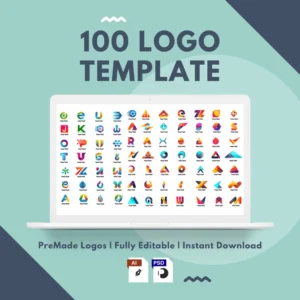
The 100 Premade Logo Templates Collection includes 100 professionally designed logo templates in AI and PSD formats.
👉 Explore the 100 Premade Logo Templates Collection
A brand should evolve as a business grows. What worked during the early stages of your business may not remain effective as your products, audience, market position, and long-term goals change.
Recognizing the signs your business needs a brand refresh can help you identify potential gaps between your current brand identity and the business you have become.
From outdated visuals and inconsistent communication to changing customer expectations and new growth opportunities, each sign provides a reason to evaluate whether your branding still represents your business effectively.
However, a brand refresh does not mean changing everything. Preserve the elements that customers already recognize while improving the areas that need attention.
Start with a clear understanding of your business direction, make thoughtful updates, and apply your refreshed identity consistently across customer touchpoints.
Ultimately, a strong brand is not simply about looking modern. It is about communicating your business’s value clearly, creating a recognizable identity, and building a consistent experience that customers can trust.