Physical Address
304 North Cardinal St.
Dorchester Center, MA 02124
Physical Address
304 North Cardinal St.
Dorchester Center, MA 02124


Canva vs PowerPoint for Video Creation is a comparison that many content creators, marketers, and business owners make when looking for an easy way to produce professional-looking videos. Both tools have evolved significantly over the years, making them capable of creating promotional videos, social media content, educational materials, and business presentations.
The challenge is deciding which platform best fits your needs.
While Canva is known for its simplicity and cloud-based workflow, PowerPoint remains a powerful and familiar option for users who want greater control over presentations and video exports.
In this guide, we’ll explore seven important differences between Canva and PowerPoint to help you choose the right tool for your projects.
The debate around Canva vs PowerPoint for Video Creation has become more relevant as both platforms continue adding video-focused features.
Today, businesses no longer need expensive editing software to create marketing videos. Instead, many professionals rely on Canva or PowerPoint to produce promotional content quickly and efficiently.
Although both tools can create videos, they serve slightly different audiences and workflows.
When it comes to simplicity, Canva has a clear advantage.
The drag-and-drop interface allows beginners to create videos without a steep learning curve. Most features are easy to find, and users can start designing within minutes.
PowerPoint is also user-friendly, but it was originally designed for presentations. As a result, some video-related features require additional steps to access and configure.
For complete beginners, the Canva vs PowerPoint for Video Creation comparison often favors Canva in terms of usability.
One of Canva’s biggest strengths is its extensive template library.
Users can choose from thousands of professionally designed templates covering:
PowerPoint also offers templates, but the library is generally smaller unless you purchase premium template collections.
In the Canva vs PowerPoint for Video Creation discussion, Canva often wins when template variety is the priority.
PowerPoint provides greater control over individual slide elements.
Advanced users can customize animations, transitions, object placements, and timing with impressive precision.
Canva prioritizes simplicity and speed, making it ideal for users who prefer convenience over advanced customization.
For users who enjoy detailed design control, Canva vs PowerPoint for Video Creation may lean toward PowerPoint.
Modern teams often work remotely.
Canva was built with collaboration in mind, allowing multiple users to edit projects simultaneously through a web browser.
This makes Canva particularly useful for:
When comparing Canva vs PowerPoint for Video Creation, PowerPoint supports collaboration as well, especially through Microsoft 365, but the experience is not always as seamless as Canva’s cloud-first environment.
Both platforms support animations and transitions, but they approach them differently.
Canva focuses on simple, visually appealing animations that are easy to apply.
PowerPoint offers a larger selection of animation controls and timing options, making it attractive for users who want detailed customization.
When evaluating Canva vs PowerPoint for Video Creation, your preference may depend on whether you value simplicity or advanced control.
Canva allows users to export videos quickly and share them directly across multiple platforms.
PowerPoint offers excellent video export functionality as well, including the ability to convert complete presentations into MP4 videos.
For marketing content, both tools are capable of producing professional-quality output.
When considering Canva vs PowerPoint for Video Creation, the real difference lies in workflow preferences rather than final video quality.
Canva is often the better choice for:
PowerPoint is often preferred for:
The best answer in the Canva vs PowerPoint for Video Creation comparison depends on your goals and experience level.
If you want speed, convenience, and a large template library, Canva is likely the better option.
If you already use Microsoft Office regularly and want more control over animations and presentation-style content, PowerPoint may be the stronger choice.
Many professionals actually use both platforms together.
They may design marketing content in Canva while creating training materials, sales presentations, and business videos in PowerPoint.
Rather than viewing the choice as Canva vs PowerPoint for Video Creation, it may be more productive to think about which tool is best suited for a particular project.
Whether you prefer Canva or PowerPoint, professionally designed templates can significantly reduce production time.
If you’re creating marketing videos regularly, check out my premium collection:
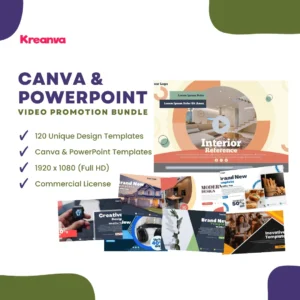
This bundle includes a wide variety of customizable templates designed for:
Instead of starting from a blank canvas or slide deck, you can customize proven designs and launch your content much faster.
The collection is suitable for entrepreneurs, agencies, freelancers, marketers, and content creators who want professional results without spending hours on design work.
👉 [CHECK FULL PRODUCT CANVA VIDEO PROMOTION]
Don’t stop here. This website contains a growing collection of free digital resources, including email templates, AI prompts, Canva templates, PowerPoint templates, planners, worksheets, and practical business guides. Browse the latest posts and discover more tools that can help you create, market, and grow more effectively.
The Canva vs PowerPoint for Video Creation debate doesn’t have a single winner because both tools excel in different areas.
Canva stands out for its simplicity, collaboration features, and extensive template library.
PowerPoint remains a powerful option for users who need greater customization, presentation-focused workflows, and detailed animation controls.
Ultimately, the best choice depends on your goals, workflow, and personal preferences.
Whichever platform you choose, using quality templates and focusing on clear messaging will have a greater impact on your results than the software itself.